
Market Research Mistakes can cost businesses valuable time, money, and growth opportunities. Whether you’re launching a new product, entering a new market, or trying to understand your customers better, effective market research is the foundation of informed decision-making. Unfortunately, many companies make avoidable mistakes that lead to inaccurate insights and poor business outcomes.
In today’s competitive business environment, understanding your target audience is more important than ever. However, simply collecting data is not enough. The quality of your research process determines the value of your findings. In this article, we’ll explore the most common market research mistakes businesses make and how to avoid them to achieve better results.
Why Market Research Matters for Business Success
It’s important to first comprehend the value of market research for business success before talking about the mistakes.
Market research can aid organisations in the following ways:
- Understand customer needs and preferences
- Identify market opportunities
- Analyze competitors
- Reduce business risks
- Improve products and services
- Make data-driven decisions
If done correctly, market research can yield valuable information that can help inform business decisions and enhance overall performance.
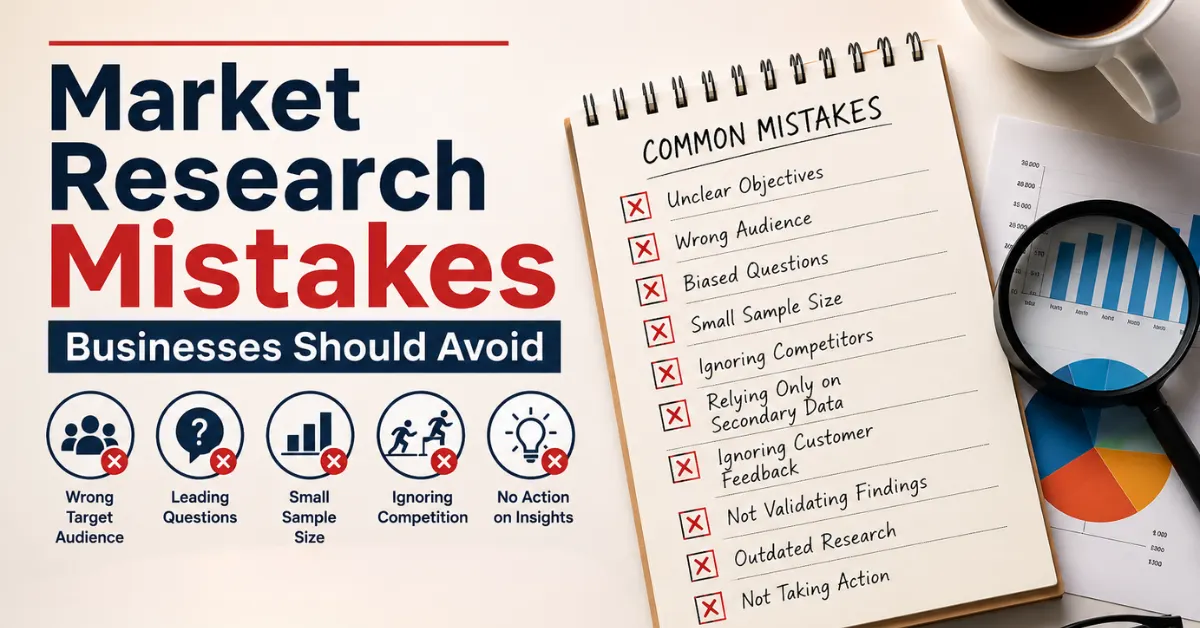
1. Starting Research Without Clear Objectives
There are some of the biggest research blunders that companies make which is to start research without having clear objectives.
Large data sets are collected by many organizations, but without a clear purpose of learning. Because of this, they get the information that is hard to interpret or apply.
Before starting any research project, ask:
- What problem are we trying to solve?
- What decisions will this research support?
- What information do we need?
If you have specific goals you won’t get lost in the process of research.
2. Researching the Wrong Audience
If you’re talking to the wrong individuals, no amount of sophisticated research techniques will get you anywhere.
Businesses are often found to be mistaken when they make assumptions about their target audience. Ideal customers are accurately depicted in your research participants. Take into account:
Consider factors such as:
- Age
- Location
- Income level
- Buying behavior
- Interests
- Industry
By focusing on the right audience, the validity and value of your results are greater.
3. Using Biased Survey Questions
A well-designed survey is crucial to research accuracy. Unfortunately, some of the most common market research errors that are made are biased questions.
Leading questions can shape the answers that participants give and lead to poor data collection.
For example:
Instead of asking:
“How much do you love our product?”
Ask:
“How satisfied are you with our product?”
Neutral wording encourages honest feedback and improves data quality.
4. Relying on Small Sample Sizes
The sample size is too small to be representative of your target market.
In some cases, a business may make decisions based on the feedback received from a few customers only. This might appear to be a cost-effective approach, but it can leave you with incorrect findings.
The greater the size and variety of your sample, the more credible your findings.
Research reliability and confidence can be greatly enhanced by investing in proper sample size.
5. Ignoring Competitor Analysis
Another horrible research error is concentrating solely on your business.
Competitor analysis can give a lot of information on:
- Market trends
- Customer expectations
- Industry standards
- Opportunities for differentiation
Knowing what your competitors are doing helps you find out what you’re missing in the market and where you can have an advantage.
Competitor research is an essential component to any market research strategy.
6. Depending Solely on Secondary Research
Secondary research involves information collected from other sources that has already been published like industrial reports, websites, publications, and databases.
Secondary research can be helpful, but can not be used to your disadvantage.
Businesses should combine:
Primary Research
- Surveys
- Interviews
- Focus groups
- Customer feedback
Secondary Research
- Industry reports
- Government data
- Market studies
- Competitor websites
A balanced approach provides more comprehensive insights.
7. Overlooking Customer Feedback
One of the most beneficial business intelligence sources is your customers.
A lot of organisations gather feedback but don’t analyse and act on it effectively.
Some customer feedback can show us:
- Product issues
- Service improvements
- Emerging trends
- Customer expectations
One of the most expensive market research blunders a business can make is to overlook this information.
Engaging with customers through listening helps to foster better relationships and customer satisfaction.
8. Failing to Validate Research Findings
The results of the research should not be accepted without verification.
It is possible for a business to make strategic decisions off of one piece of information. This heightens the chance of error.
Rather, confirm through the use of several approaches.
For example:
- Compare survey results with sales data
- Verify trends using customer interviews
- Cross-check insights with industry reports
If you validate, you will be more confident in your conclusions and will lessen the risk in your decision making.
9. Ignoring Market Trends
Markets are constantly evolving.
Consumer preferences, technologies, and competitive landscapes change rapidly. Businesses that rely on outdated information may struggle to remain relevant.
Successful organizations continuously monitor:
- Industry developments
- Consumer behavior shifts
- Economic changes
- Emerging technologies
Keeping research up to date ensures business strategies remain effective and competitive.
10. Failing to Turn Insights Into Action
Perhaps the most overlooked market research mistake is failing to use the insights collected.
Many companies invest significant resources into research but never implement the findings.
Research should lead to action.
For example:
- Adjust marketing campaigns
- Improve products
- Enter new markets
- Enhance customer experiences
- Refine pricing strategies
The true value of market research comes from applying insights to business decisions.
Best Practices to Avoid Market Research Mistakes
To improve the effectiveness of your market research efforts, follow these best practices:
Define Clear Research Goals
Establish specific objectives before collecting data.
Use Multiple Research Methods
Combine qualitative and quantitative approaches for better insights.
Focus on the Right Audience
Ensure participants accurately represent your target market.
Analyze Competitors Regularly
Monitor industry competitors and benchmark performance.
Continuously Update Research
Review market trends and customer preferences regularly.
Act on Research Findings
Translate insights into measurable business actions.
The Future of Market Research in 2026
Modern market research is increasingly powered by technology. Artificial intelligence, advanced analytics, automation, and predictive modeling are transforming how businesses gather and analyze information.
Organizations that embrace data-driven research practices will be better positioned to understand customer behavior, identify opportunities, and respond to market changes.
As markets become more competitive, avoiding common market research mistakes will be essential for sustainable growth and long-term success.
Conclusion
Market research is one of the most powerful tools businesses can use to make informed decisions. However, even the best intentions can lead to poor outcomes when common market research mistakes are overlooked.
By defining clear objectives, targeting the right audience, using unbiased research methods, analyzing competitors, and acting on insights, businesses can significantly improve the effectiveness of their research efforts.
Companies that avoid these mistakes will gain deeper customer insights, reduce business risks, and make smarter strategic decisions in an increasingly competitive marketplace. Effective market research is not just about collecting data—it’s about transforming information into meaningful business growth.