
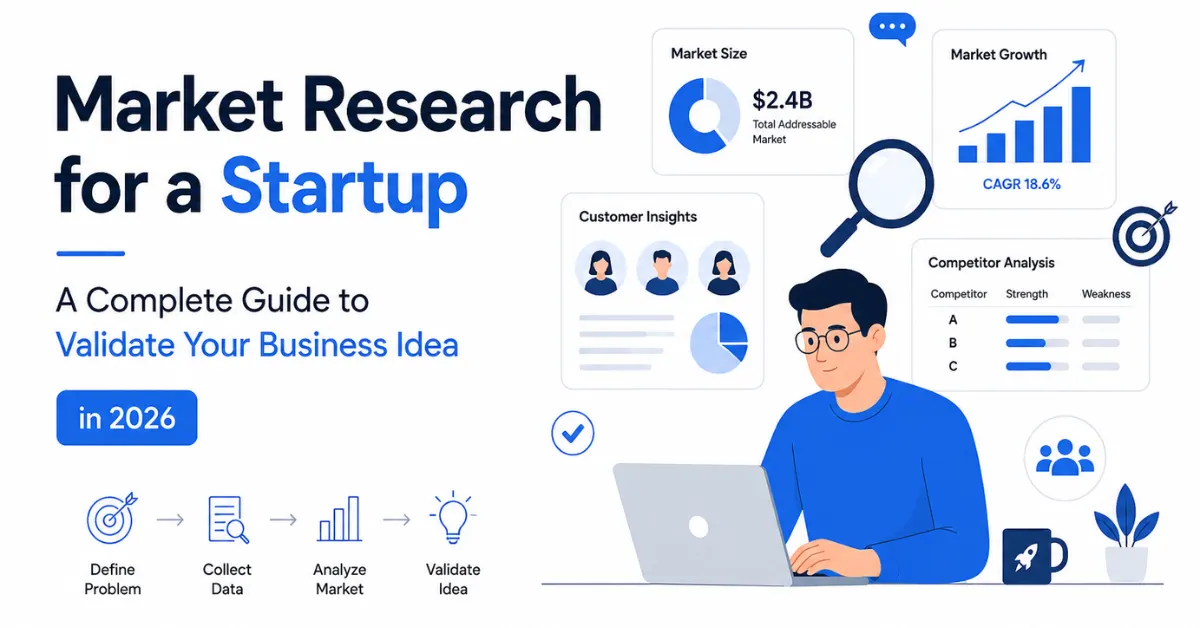
market research for a startup. However, a lot of startups fail not because their products are bad, but because they never get to understand their customers, their competition, and the trends in their industry before getting in there. By doing market research, entrepreneurs can make informed decisions, minimize risks, and uncover growth opportunities.
From start-ups to online retailers, consulting firms to local businesses, market research can be a lifesaver that can guide you to a viable product that people are interested in purchasing.
You will discover how to do some market research for a start-up, what your target market is, how to analyse your competition, and how to test your business idea and not waste a lot of your time and money.
What Is Market Research for a Startup?
Market research for a start up involves gathering, analysing and interpreting data from your target market, your customers, your competitors and the industry.
The goal is to answer critical questions such as:
- Is there demand for my product or service?
- Who are my ideal customers?
- What problems do customers face?
- Who are my competitors?
- How can I differentiate my business?
- What pricing strategy should I use?
Market research enables startups to make decisions based on customer insights and actual data, rather than on assumptions.
Why Is Market Research Important for Startups?
It’s just like trying to start a business without doing some research. You might get there at the end of the day, but you will end up spending time, money and resources.
Here are some key benefits of market research:
1. Validates Your Business Idea
Research is used to see if there is a need for your product/service. This minimises the risk of creating something that nobody wants.
2. Identifies Your Target Audience
Knowing your audience enables the development of products, marketing campaigns and customer experiences that will fit their needs.
3. Reduces Business Risks
There is a risk in making decisions based on assumptions and making data-driven decisions is generally safer.
4. Reveals Market Opportunities
Research can find opportunities for a market that the competitors are not considering.
5. Improves Marketing ROI
Once you understand your customers, you can create targeted and cost-effective marketing campaigns.
Step 1: Define Your Research Objectives
Before collecting data, identify what you want to learn.
Common startup research objectives include:
- Understanding customer needs
- Evaluating market demand
- Identifying competitors
- Testing product concepts
- Determining pricing strategies
- Exploring new market opportunities
Having clear objectives will assist you in limiting your research and avoid collecting extraneous data.
Step 2: Identify Your Target Audience
One of the most important parts of market research for a startup is understanding your ideal customers.
Ask questions such as:
- What is their age group?
- Where do they live?
- What is their income level?
- What challenges do they face?
- What products do they currently use?
- How do they make purchasing decisions?
Creating customer personas can help visualize your target audience.
Example Customer Persona
Name: Rahul Sharma
Age: 28
Occupation: Marketing Executive
Challenge: Wants affordable AI tools to improve productivity
Goal: Save time and improve work efficiency
This type of awareness enables startups to develop more relevant solutions.
Step 3: Conduct Competitor Analysis
Competitor research will provide you with an understanding of what is successful and what is not with other companies.
Analyze:
- Products and services
- Pricing models
- Marketing strategies
- Customer reviews
- Website content
- Social media presence
Identify patterns of customer complaints. They frequently uncover areas for enhancement for you.
For instance, if your rivals have bad customer support, then your startup can market itself as quick and responsive to customers.
Step 4: Use Primary Market Research
Primary research is the collection of new data from customers.
Common methods include:
Surveys
Online surveys are cost-effective and easy to distribute.
Questions may include:
- What problem are you trying to solve?
- How do you currently solve it?
- What features are most important to you?
- How much would you pay for a solution?
Interviews
Personal interviews can offer more in-depth information than questionnaires.
You can learn about what makes customers happy, what pisses them off, and what they hope for.
Focus Groups
Startups can use focus group to collect data from multiple people simultaneously.
Such conversations may uncover patterns and general customer issues.
Step 5: Use Secondary Market Research
Secondary Research is the process of utilizing information from sources that already exists.
Examples include:
- Industry reports
- Government data
- Research publications
- Market analysis reports
- Trade associations
- Competitor websites
Secondary research can be more time efficient and cost-effective than primary research.
Primary and Secondary research is generally used together to give the best idea about the market.
Step 6: Analyze Market Trends
Knowing the market trends can help any startup stay ahead of the pack.
Some areas to evaluate include:
Technology Trends
The world of technology is rapidly changing, with AI, automation, and data analytics being some of the emerging trends that are transforming industries.
Consumer Behavior Trends
Customers increasingly value:
- Convenience
- Personalization
- Sustainability
- Fast service
- Digital experiences
Industry Growth Trends
Identify growth areas of industry.
New markets are more likely to create new business opportunities for startups than saturated markets.
Step 7: Validate Your Startup Idea
Validation helps determine whether customers are willing to pay for your solution.
Methods include:
Create a Landing Page
Create a basic landing page with information about your product idea.
Measure:
- Website traffic
- Email signups
- Conversion rates
Launch a Minimum Viable Product (MVP)
MVP contains only the minimum features that are necessary to resolve the customer’s problem.
This enables startups to gain user feedback before investing in bigger stock.
Pre-Sales Campaigns
If customers are willing to purchase before launch, that’s a strong indicator of market demand.
Step 8: Evaluate Market Size
Once you know the size of the market, you can calculate the potential growth.
Three key metrics include:
Total Addressable Market (TAM)
The maximum possible revenue that could be realized if all your potential customers bought your product.
Serviceable Available Market (SAM)
The segment of the market your startup can reasonably reach.
Serviceable Obtainable Market (SOM)
The percentage of the market that you can access in the short term.
These metrics are especially significant when obtaining investors or creating a business plan.
Common Market Research Mistakes Startups Should Avoid
Even experienced entrepreneurs make research mistakes.
Here are some common ones:
Relying on Assumptions
Always validate assumptions with actual customer data.
Researching Too Small a Sample
A limited sample may not accurately represent the broader market.
Ignoring Competitors
Understanding competitors is essential for differentiation.
Collecting Data Without Analysis
Data only becomes valuable when transformed into actionable insights.
Focusing Only on Positive Feedback
Constructive criticism often provides the most valuable opportunities for improvement.
Best Tools for Market Research in 2026
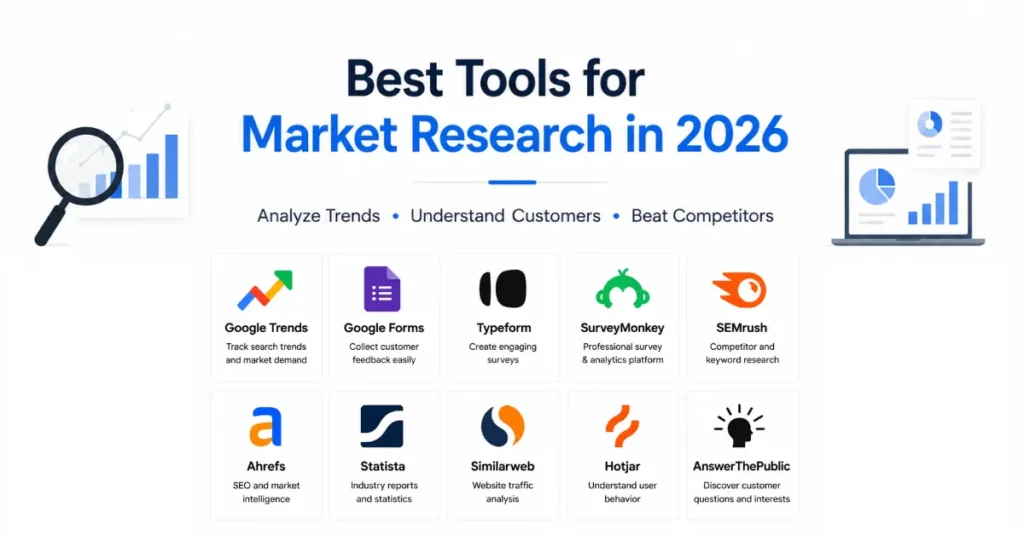
Several tools can help startups conduct efficient market research:
- Google Trends
- Google Forms
- Typeform
- SurveyMonkey
- SEMrush
- Ahrefs
- Statista
- Similarweb
- Hotjar
- AnswerThePublic
These can help you learn more about your customers, their search patterns and the competition you are dealing with.
Final Thoughts
Market research for a start up is not a single time endeavor. Markets change, customers change and so does competition. Successful startups regularly take feedback, track trends and adjust strategies accordingly.
Knowing your target audience, studying your competition, testing your ideas and monitoring the trends in your industry can greatly improve your prospects for success.
Do a lot of marketplace analysis before getting into spending a lot of money on product development or marketing. The knowledge you acquire now can help you avoid expensive wrong turns later and give your startup a sure shot for development.