
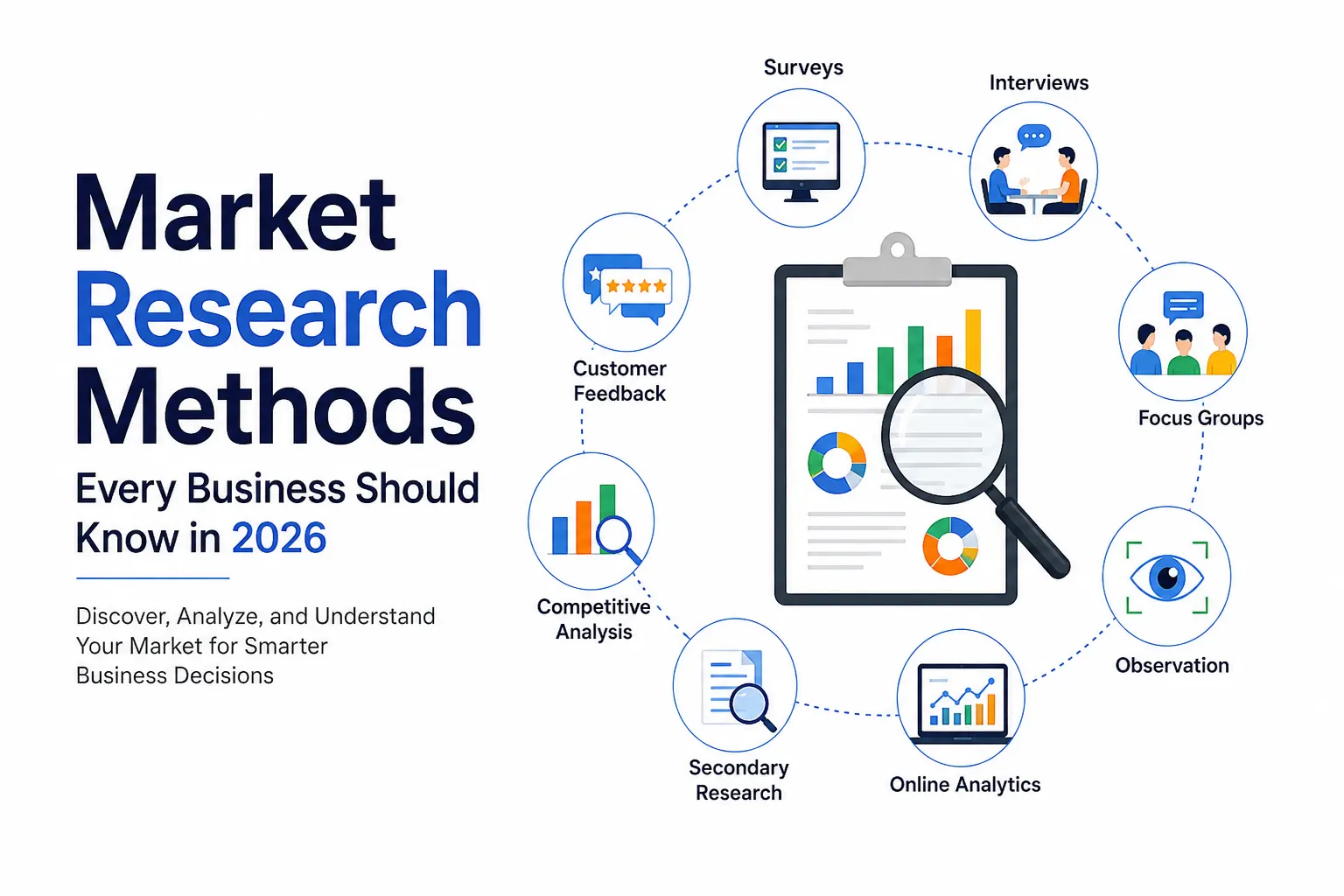
Knowing what customers, competitors, and market trends are in today’s competitive business landscape is a must. Companies utilizing assumptions typically find it difficult to make data-driven choices, and companies that invest in Market Research Methods find themselves better equipped with insights to help lower risks, enhance products, and uncover opportunities.
You can make a huge difference by selecting the right market research method if you are a start-up firm that is launching a new product or an established company that is looking to expand. Research can enable organizations to gain insight into their customers’ preferences, assess market demand, and make informed decisions that will result in long-term success.
We’ll discuss the most crucial Market Research Methods that every business needs to know and how they can provide a competitive edge.
What Are Market Research Methods?
Market Research Methods are used to gather, analyse and interpret information related to the market, its customers and its competitors. These techniques can aid businesses in grasping the behavior of their customers, recognizing trends, analyzing opportunities, and creating strategies. The main purpose of market research is to minimize risk and aid in decision-making. Instead of making any guesses, companies can base their product development, marketing campaigns, pricing, and expansion strategies on the findings of the research.
Why Market Research Matters
Understanding why market research is key is important prior to considering various types of research.
Market Research is used for businesses to:
- Understand customer needs and preferences
- Identify market opportunities
- Reduce business risks
- Improve products and services
- Analyze competitors
- Enhance marketing effectiveness
- Support strategic planning
Those companies that regularly engage in business research will be better equipped to adjust to market conditions and expectations.
1. Primary Market Research
Primary Market Research is the collection of data that is gathered from the target audience for the first time. Specifically collected information for your business goals and very relevant insights.
Common methods of primary research are:
Surveys
One of the most common consumer research techniques is the survey. Surveys can be given online, via email, social media or in person.
Surveys can be used to collect information on:
- Customer satisfaction
- Buying behavior
- Product preferences
- Brand awareness
- Customer expectations
One benefit of surveys is that they can be sent to a large number of people in a short time and the data can be quantified.
Interviews
Interviews are more in-depth than surveys because they can go beyond the questions and allow the customer to expound on their opinion.
Businesses often use interviews to understand:
- Customer experiences
- Pain points
- Purchase motivations
- Product feedback
Interviews are subject-based, and can often provide information that a structured survey cannot.
Focus Groups
Focus groups are small group discussions about products, services or concepts.
These sessions help businesses:
- Test new product ideas
- Evaluate marketing messages
- Understand customer perceptions
- Discover emerging needs
The benefit of focus groups is that they offer in-depth qualitative feedback, which can be used to assist product development and branding
2. Secondary Market Research
Secondary Market Research is a technique that entails gathering available data previously obtained from other sources.
Common sources include:
- Industry reports
- Government publications
- Research studies
- Market analysis reports
- Competitor websites
- Trade associations
Secondary research can be a cheaper alternative to primary research and can also be used to get background information prior to primary research. Secondary research is often used for businesses to know the market size, industry trends, and competitive landscape.
3. Quantitative Research
Quantitative research focuses on numerical data and statistical analysis.
This approach answers questions such as:
- How many customers prefer a product?
- What percentage of users are satisfied?
- How often do customers purchase?
Examples include:
- Online surveys
- Polls
- Customer satisfaction ratings
- Website analytics
Quantitative research is important because of the measurable results it provides which can be analysed objectively.
When it comes to pricing, market segmentation, and acquisition strategies, quantitative Market Research Methods are frequently used in business decision-making.
4. Qualitative Research
Qualitative research efforts are about gaining insight into customers’ attitudes, motivations, feelings and experiences.
Rather than numbers, qualitative research explores the reasons behind customer behavior.
Common qualitative methods include:
- Focus groups
- In-depth interviews
- Customer observation
- Open-ended survey questions
This will help businesses to gain insight into why customers make their decisions and what factors affect their buying habits.
Qualitative research is often used in tandem with quantitative research to get the full picture of the target market.
5. Competitive Analysis
One of the best ways to do market analysis for a business is through competitive analysis.
This method involves studying competitors to understand:
- Product offerings
- Pricing strategies
- Marketing campaigns
- Customer reviews
- Strengths and weaknesses
Businesses are able to identify the market gaps when they analyze their competitors and come up with a strategy to differentiate their products or services.
Competitive research also enables organisations to predict changes in the industry and act accordingly on new problems in the market.
6. Customer Observation Research
Customer observation refers to observing customers in the real world with their products, services or environments.
Businesses may observe:
- Shopping behavior
- Website navigation
- Product usage
- Service interactions
During the observation research process, behaviors are likely to emerge that might not be reported accurately in survey or interview responses.
This approach can be especially helpful to enhance the customer experience and uncover usability problems.
7. Online Analytics and Digital Research
Businesses today have an abundance of digital data available thanks to analytics tools.
Online research includes analyzing:
- Website traffic
- User behavior
- Search trends
- Social media engagement
- Conversion rates
For instance, Google Analytics, Google Search Console, and customer relationship management tools offer valuable insights into customer actions and preferences.
Digital analytics is one of the most crucial Market Research Methods as it helps in obtaining real-time data which can aid in quicker decision-making.
Choosing the Right Market Research Method
The choice of research method will vary according to your business objectives, budget and audience.
Consider the following:
- Use surveys for large-scale customer feedback.
- Use interviews for detailed customer insights.
- Use focus groups to test new concepts.
- Use competitive analysis to understand market positioning.
- Use analytics tools for ongoing customer behavior tracking.
- Use secondary research for industry knowledge and market trends.
In many situations, it is best for businesses to utilize many different research methodologies.
Common Mistakes to Avoid
While conducting research, businesses should avoid several common mistakes:
- Relying on assumptions instead of data
- Using small or biased samples
- Ignoring customer feedback
- Failing to analyze competitors
- Collecting data without clear objectives
- Not updating research regularly
Successful market research requires a structured approach and continuous evaluation.
The Future of Market Research

Businesses are changing the way they gather and process information with the help of technology. Market research is becoming more accurate and faster with the power of Artificial Intelligence, predictive analytics and automation.
In today’s day and age, it is possible to process a large amount of customer data, identify patterns, and get actionable business insights in more efficient ways than ever before.
With so much competition in the market, companies that invest in their advanced research capabilities will have the best chance of understanding customer needs and adjusting to market changes.
Conclusion
To achieve business success, it is very important to know and utilize the appropriate Market Research Methods. Market research can be conducted via surveys, interviews, focus groups, competitive analysis or using digital analytics to gain the insights necessary to make informed decisions and limit uncertainty.
Good research can help businesses ride the opportunities, enhance customer satisfaction, and enable sustainable growth. Leveraging several market research methods and tracking market trends on an ongoing basis can help organizations maintain a competitive edge and make informed business decisions.
Our aim at CognitiaX Analytics is to turn data into insight for businesses, by delivering sophisticated market research, consumer analysis and business intelligence solutions. Choosing proper research techniques now can lead to better business results in the future.